

The Lifecycle of an RV Battery: How Age, Temperature & Charging Habits Shorten Its Life
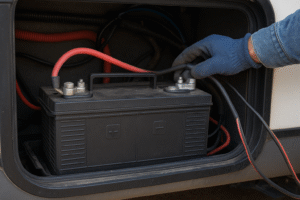
Every RV relies on a healthy battery system to power lights, slides, jacks, appliances, and electronics. But even the best RV batteries don’t last forever. Their lifespan is shaped by age, climate, charging patterns, and how deeply they’re discharged. Understanding what shortens a battery’s life helps RVers traveling to or staying at Cape Kennedy RV Resort keep their rigs powered reliably throughout every season on Florida’s Space Coast.
All RV batteries start to age the moment they’re manufactured. Over time, internal chemical reactions become less efficient, reducing capacity and the ability to hold a charge. Even a battery that appears fully charged may deliver far less usable energy than when it was new. In warm climates, this aging process accelerates dramatically.
Temperature is one of the biggest factors affecting RV battery health. Florida’s heat can be brutal on lead-acid batteries. High temperatures speed up chemical breakdown, causing plates to corrode and electrolyte to evaporate more quickly. For every 15–20 degrees above room temperature, battery lifespan can be cut in half. At Cape Kennedy RV Resort, where sunshine and humidity dominate most of the year, batteries that might last six years in northern states often need replacement after three to four.
Cold weather affects batteries too, though in a different way. While cold doesn’t typically shorten long-term lifespan like heat does, it reduces immediate performance and slows chemical reactions. For RVers traveling north in winter or returning to colder climates, a battery that’s already weakened by Florida heat may struggle even more when temperatures drop.
Charging habits are just as important as temperature. Lead-acid batteries—especially flooded and AGM types—need proper charging voltages to stay healthy. Undercharging allows sulfation to build up on the plates, reducing capacity and causing the battery to “feel” weak. Overcharging, on the other hand, boils off electrolyte and damages internal components. Both extremes shorten lifespan significantly.
Depth of discharge also plays a major role. Draining a battery too far, too often dramatically reduces its total cycle life. A battery routinely discharged to 50% may last twice as long as one regularly drained to 20%. Many RVers unknowingly tax their batteries by running inverters, refrigerators, and fans on 12-volt power without monitoring voltage levels.
Converters and chargers inside RVs vary widely in quality. Older converters often charge at a single voltage, which can overcharge or undercharge depending on battery condition. Modern multi-stage chargers protect against this by adjusting the voltage through bulk, absorption, and float cycles. Without a proper charger, even a brand-new battery will degrade prematurely.
Parasitic loads—small 12-volt draws that continue even when the RV seems “off”—also contribute to shortened battery life. Propane detectors, radio memory, inverter boards, Wi-Fi boosters, and refrigerator controls slowly drain batteries while parked. If the battery isn’t receiving a steady charge, these loads create chronic undercharging and sulfation.
Salt air and coastal humidity near Cape Kennedy can also impact battery terminals and wiring. Corrosion increases resistance, reducing charging efficiency and causing the battery to work harder for the same output. Regular cleaning and dielectric grease help combat this subtle but significant source of battery strain.
Storage practices matter as well. Batteries left discharged for long periods suffer permanent capacity loss. Conversely, batteries stored fully charged and maintained with a smart charger or solar trickle charger last much longer. RVers parking at Cape Kennedy for the winter benefit greatly from consistent float charging to maintain full health.
Lithium batteries behave differently but are not immune to lifespan limitations. While they handle deeper discharges and hotter climates better than lead-acid, they can still degrade from overcharging, extreme heat, or improper storage. Their longer lifespan makes them attractive for full-timers, but proper care remains essential.
Understanding the lifecycle of RV batteries helps owners extend their usefulness and avoid unexpected failures. By managing temperature exposure, using proper charging equipment, preventing deep discharges, and monitoring battery condition, RVers can significantly extend the life of their electrical system. Reliable batteries mean fewer interruptions, safer travels, and a more comfortable stay at Cape Kennedy RV Resort, where dependable power makes every coastal adventure better.
📍 4513 St Rd 46, Mims, FL
For any questions or concerns please reach out to us
📞 (321) 269-7361