

How Trailer Aerodynamics Affect Fuel Efficiency at Highway Speeds
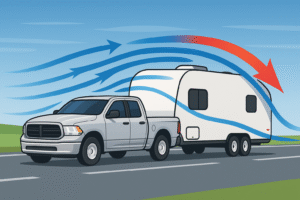
Many RVers notice a sharp drop in fuel economy the moment they hitch up a travel trailer—but few understand just how much aerodynamics influence that loss. At highway speeds, wind resistance becomes the dominant force working against your tow vehicle. For guests traveling to Meadowlark Shores RV Resort, understanding trailer aerodynamics can help you tow more efficiently, reduce fuel costs, and enjoy a smoother driving experience.
A trailer’s shape creates a massive amount of drag, the aerodynamic force that resists forward motion. Because most RV trailers are tall, flat-fronted, and box-shaped, they capture air like a wall being pushed down the highway. The faster you drive, the greater the force of drag—rising exponentially with speed—which is why towing at 70 mph burns far more fuel than towing at 60.
One of the biggest contributors to drag is the gap between the tow vehicle and the trailer. As air flows off the back of the truck or SUV, it spirals into this gap and creates turbulence. That turbulence generates suction that pulls backward on the trailer, reducing efficiency. Longer gaps create more turbulence, while shorter, optimized spacing allows smoother airflow.
The flat front of most travel trailers also causes pressure drag. When your trailer hits the wind, air must slow down and divide around the body. This sudden deceleration increases air pressure at the front, making the engine work harder. Rounded or V-nose trailers reduce this pressure buildup and improve fuel economy.
Another aerodynamic factor is the wake zone. Behind the trailer, low-pressure air creates a vacuum that pulls rearward on the rig. This wake becomes larger and more chaotic with taller and boxier trailers. Accessories such as roof air conditioners, antennas, and cargo pods increase height and worsen aerodynamic drag.
Crosswinds complicate things further. Side winds create side-force drag, causing sway and forcing the driver to make constant steering corrections. A larger, taller trailer has more surface area for wind to push against, which not only reduces efficiency but can also increase driver fatigue.
Towing mirrors, roof racks, and open truck beds can introduce additional aerodynamic losses. Every exposed surface disrupts airflow, especially when combined with the trailer’s already significant drag profile. Even the angle of the trailer relative to the tow vehicle—known as yaw—affects stability and fuel economy.
Weight distribution also plays a surprising role. When a trailer is nose-high or nose-low, airflow becomes uneven across the top and bottom surfaces. A level trailer produces smoother airflow and less drag. Weight-distribution hitches help maintain proper geometry, ensuring that both the tow vehicle and trailer sit level while moving.
Speed has the single greatest impact on aerodynamic drag. Because drag increases exponentially—not linearly—every 10 mph above 55 mph results in dramatically higher fuel consumption. Slowing from 70 mph to 60 mph can improve fuel economy by 15–20% for many RVers.
Aerodynamic add-ons can help, though results vary. Fairings, gap reducers, trailer nose cones, and vortex generators are designed to smooth airflow and reduce drag. While not a cure-all, they can provide modest fuel savings for long-distance travelers, especially on boxier older trailers.
Tire pressure also affects drag and resistance. Underinflated tires deform more, increasing rolling resistance and reducing efficiency. Maintaining proper tire pressure ensures that the majority of drag comes from aerodynamics—not the tires themselves.
Ultimately, towing efficiency is a combination of design, setup, and driving habits. While travel trailers will never be aerodynamic, understanding the forces at play helps RVers make smarter decisions on the road. By reducing speed, maintaining proper trailer height, minimizing roof accessories, and managing the gap between tow vehicle and trailer, guests at Meadowlark Shores RV Resort can enjoy better fuel economy and smoother towing on every trip.
📍 4513 St Rd 46, Mims, FL
For any questions or concerns please reach out to us
📞 (321) 269-7361