

Solar Charge Controllers Explained: PWM vs. MPPT & Why It Matters
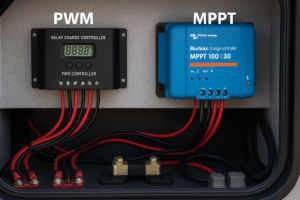
As more RVers embrace solar power to support off-grid capability, reduce electrical load, and enjoy quieter camping, one component determines how efficiently all that rooftop sunlight becomes usable energy: the solar charge controller. For guests at Cape Kennedy RV Resort, where sunshine is plentiful and coastal breezes keep panels cool, understanding the difference between PWM and MPPT controllers can dramatically improve how well your solar setup performs.
A solar charge controller regulates voltage and current from the solar panels to the RV’s battery bank. Without one, even a modest solar array could overcharge or permanently damage your batteries. Controllers ensure that power is delivered safely, consistently, and according to proper charging profiles.
The most affordable and commonly installed units are PWM (Pulse Width Modulation) controllers. These work by rapidly switching the connection between the panel and the battery on and off. As the battery nears full, the controller shortens the pulses to prevent overcharging. This method is simple and reliable—ideal for small setups—but it comes with limitations.
PWM controllers force your solar panels to operate at the battery’s voltage, sacrificing efficiency. A 100-watt panel that naturally produces 18 volts must be dragged down to around 12–14 volts to match the battery. The result? Lost charging power, especially noticeable during peak Florida sunshine when your panels could be performing their best.
This is where MPPT (Maximum Power Point Tracking) controllers shine. MPPT technology actively analyzes panel output and battery status to capture the maximum available power at any given moment. Instead of reducing panel voltage to battery levels, MPPT units convert excess voltage into additional charging amperage—often boosting efficiency by 20–40% or more.
For RVers at Cape Kennedy, MPPT controllers offer another big advantage: they handle fluctuations caused by coastal weather. Cloud cover, ocean breezes, and brief sun-to-shade transitions can disrupt panel output. MPPT units adjust instantly to these changes, extracting far more usable power than PWM controllers in variable lighting.
MPPT setups also allow panels to be wired in series, increasing voltage and reducing cable loss. This is especially helpful on modern RVs where multiple panels must be spaced around AC shrouds, antennas, and roof vents. Higher voltage improves efficiency in long cable runs—important for larger solar arrays.
PWM controllers still serve a purpose. If your RV relies on a single maintenance panel to keep a lead-acid battery topped off, PWM is inexpensive, simple, and durable. But for serious solar users—those running 12-volt fridges, CPAP machines, Starlink systems, or large lithium banks—MPPT is almost always the better choice.
Battery type also matters. Lithium batteries, increasingly popular among modern RVers, accept higher charge rates and require more precise voltage regulation. MPPT controllers deliver the consistent amperage lithium systems thrive on, while PWM controllers often undercharge them.
Coastal environments add another layer of consideration. Heat and salt-air exposure can reduce panel voltage, which affects PWM performance more severely. MPPT controllers compensate automatically, helping RVers at Cape Kennedy maintain strong charging even on hotter days.
For travelers expanding or upgrading solar over time, MPPT provides excellent future-proofing. Larger battery banks, higher-wattage panels, and advanced monitoring systems integrate seamlessly. PWM, on the other hand, often caps out early and requires a full system overhaul as needs grow.
Ultimately, choosing between PWM and MPPT depends on how you camp. Light users with minimal electrical demand may see no difference. But for snowbirds wintering at Cape Kennedy RV Resort, off-grid explorers, and RVers who rely heavily on solar to power daily life, the improved efficiency of MPPT delivers more energy, healthier batteries, and reliable performance.
A well-chosen solar charge controller ensures your RV stays powered through every sunrise—whether you’re watching rockets launch nearby or enjoying quiet coastal evenings under the Florida sky.
📍 4513 St Rd 46, Mims, FL
For any questions or concerns please reach out to us
📞 (321) 269-7361