

The Physics of Trailer Bounce: Springs, Shocks & Tow Vehicle Geometry
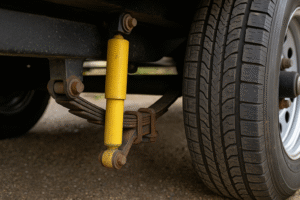
Trailer bounce is one of the most misunderstood issues RVers encounter on the road. Whether you’re towing a travel trailer through Florida or maneuvering into your site at Meadowlark Shores RV Resort, excessive bouncing can make towing uncomfortable, unsafe, and damaging to your RV’s structure. The root cause comes down to physics—specifically how springs, shocks, weight, and tow-vehicle geometry all interact at highway speeds.
Every trailer depends on its suspension system to absorb bumps and uneven pavement. Most RV trailers use leaf springs, which flex to absorb energy. But leaf springs can also store and release that energy like a springboard, creating an oscillation known as harmonic bounce. When the bouncing matches the natural frequency of the trailer’s suspension, the movement becomes more dramatic.
Shocks play a critical role in controlling this oscillation. Without shock absorbers, springs continue to rebound multiple times after hitting a bump. Many RV trailers don’t come equipped with shocks from the factory, making bounce far more noticeable. Upgrading to a shock-equipped suspension dramatically reduces rebound and stabilizes the ride.
Tire pressure also affects bounce. Overinflated tires behave like stiff springs, transferring more road energy into the trailer rather than absorbing it. Underinflated tires, on the other hand, cause swaying and heat buildup. The correct pressure creates a balanced contact patch that dampens vibrations before they reach the trailer frame.
Weight distribution is another major factor. A trailer with too little tongue weight tends to bounce, sway, and “porpoise” during acceleration or braking. Ideally, tongue weight should be 10–15% of the trailer’s total weight. Too little nose weight causes the trailer to behave like a seesaw, making bounce worse at highway speeds.
Tow-vehicle geometry also determines how smoothly your trailer rides. If the hitch height is too high or too low, the trailer won’t tow level. A nose-high trailer exaggerates bounce because the rear suspension is doing all the work. A nose-low trailer causes excessive load transfer to the tow vehicle, amplifying dips and rises.
The wheelbase of the tow vehicle matters, too. Shorter wheelbase vehicles tend to pitch more when towing, and that pitching transfers movement to the trailer tongue. Longer wheelbase trucks provide greater stability because the distance between axles resists vertical movement.
Road surface resonance is another physics-based issue. Concrete highway joints, badly spaced bridge seams, or uneven pavement can create repeating impacts that match the trailer’s natural suspension frequency. When this happens, even a perfectly loaded trailer can experience rhythmic bounce. Proper damping (shocks) is the best solution.
The trailer’s frame stiffness also plays a role. Lightweight RV frames are flexible and can amplify bouncing rather than absorbing it. While frame upgrades aren’t practical, improving suspension components helps compensate for chassis flex.
Speed influences trailer bounce more than most RVers realize. Every suspension system has a harmonic speed—typically between 45–65 mph—where bounce becomes more pronounced. Adjusting your speed just 3–5 mph up or down can break the oscillation and smooth out the ride instantly.
Weight-distribution hitches also help control bounce. Their built-in spring bars transfer weight forward, reducing the tendency for the tow vehicle and trailer to pivot independently. Some premium hitches include sway control and friction damping that reduce bounce even further.
Ultimately, minimizing trailer bounce is about balance, damping, and geometry. By ensuring proper tongue weight, leveling the trailer, optimizing tire pressure, and adding shocks or upgraded suspension components, RVers can dramatically improve tow comfort and safety. Understanding the physics behind bounce helps every guest at Meadowlark Shores RV Resort enjoy smoother towing and reduced wear on their RVs—whether they’re arriving for the season or heading out on their next adventure.
📍 4513 St Rd 46, Mims, FL
For any questions or concerns please reach out to us
📞 (321) 269-7361